
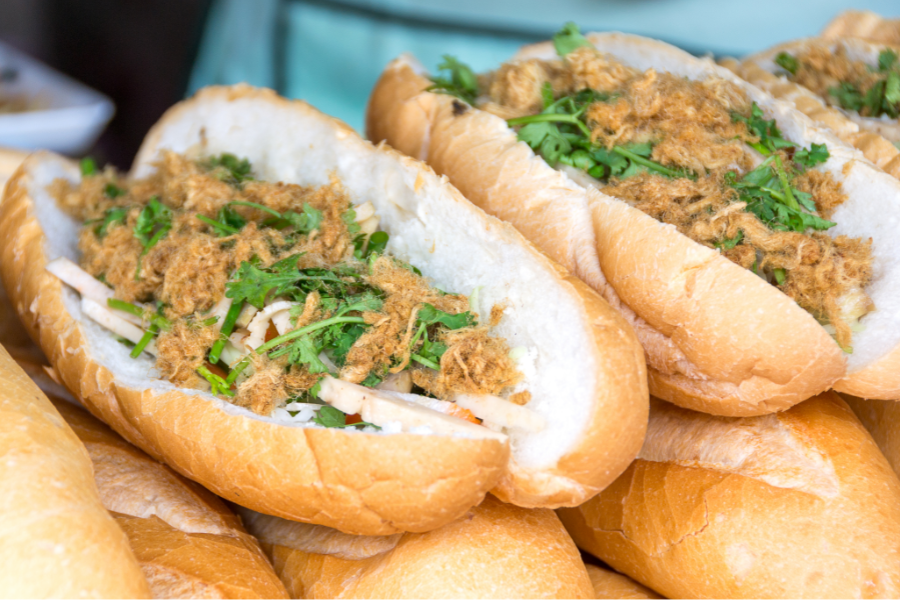
Crispy baguette stuffed with lemongrass chicken, tangy pickled daikon, cilantro, jalapeños, and mayo. Uses chicken instead of traditional meat.
Nutrition & Info
Allergen Warnings
Equipment Needed
Presentation Guide
Vessel: paper-wrapped baguette
Garnishes: fresh cilantro, sliced jalapeño
Accompaniments: pickled daikon and carrot (đồ chua)
Instructions
-
1
Combine the minced lemongrass, fish sauce, sugar, and garlic in a bowl. Add the chicken thighs and turn to coat evenly, then cover and marinate in the refrigerator for at least three hours or preferably overnight for maximum flavour.
-
2
Prepare the quick pickles by dissolving the sugar and salt in the warm water and rice vinegar. Add the julienned daikon and carrots, toss well, and refrigerate for at least one hour, stirring occasionally to ensure even pickling.
-
3
Preheat a grill pan or outdoor grill to medium-high heat and brush lightly with oil. Grill the marinated chicken thighs for five to six minutes per side until lightly charred on the edges and cooked through to an internal temperature of seventy-five degrees.
-
4
Allow the grilled chicken to rest for three minutes on a cutting board, then slice each thigh on the bias into thin strips about half a centimetre thick. This resting period helps the juices redistribute throughout the meat evenly.
-
5
Split the baguettes lengthwise without cutting all the way through. If the bread is not already crispy, place cut-side down in a dry skillet or in a hot oven for two to three minutes until the exterior is crackling and warm.
-
6
Spread a generous tablespoon of mayonnaise on the bottom half of each baguette. Layer the sliced grilled chicken evenly along the length, followed by a generous handful of well-drained pickled daikon and carrot.
-
7
Top with cucumber strips, several sprigs of fresh cilantro, and sliced jalapeño peppers to taste. Close the sandwich gently and press lightly to compact the fillings without crushing the crispy baguette, then serve immediately.
Did You Know?
Vietnamese baguettes are lighter than French ones because rice flour is added to the dough.
Chef's Notes
Equipment Tips
- oven or toaster
- sharp knife
- cutting board
Garnishing
fresh cilantro, sliced jalapeño
Accompaniments
pickled daikon and carrot (đồ chua)
The Story Behind Bánh mì
### The Story
Banh mi is the ultimate expression of Franco-Vietnamese culinary fusion. The French introduced the baguette to Vietnam in the 1860s at the start of their colonial rule. Initially a luxury made from imported wheat, the Vietnamese baguette was transformed during World War I when bakers began mixing in rice flour to compensate for wheat shortages, inadvertently creating the lighter, crispier bread that defines banh mi today. Until the 1950s, sandwiches in Vietnam closely followed French formulas -- jambon-beurre with pate. The distinctly Vietnamese transformation came in mid-century Saigon, where vendors layered pickled daikon and carrots, fresh cilantro, cucumber, chili, and Vietnamese cold cuts onto the adapted baguette, creating the modern banh mi.
### On the Calendar
Banh mi has no seasonal association. It is eaten year-round as a quick breakfast, lunch, or snack, available from countless street vendors, bakeries, and market stalls across Vietnam.
### Then & Now
Following the Vietnam War, overseas Vietnamese communities popularized banh mi in Australia, Canada, and the United States, where it has become one of the world's most celebrated sandwiches. Modern variations range from classic cold cuts with pate to grilled lemongrass chicken, sardine, and vegetarian versions. The sandwich's affordability, portability, and explosive flavor combination have made it a global street-food icon.
### Legacy
Banh mi is the edible proof that colonialism's legacy can be subverted -- the French brought the bread, but the Vietnamese made it their own, creating something neither culture could have produced alone.
Comments (0)
Log in to leave a comment.
No comments yet. Be the first to share your thoughts!