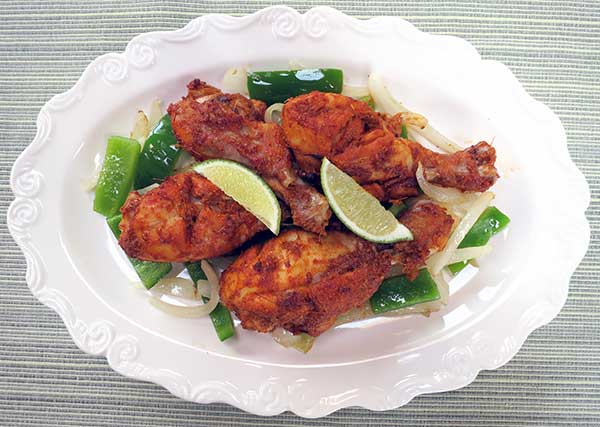
Whole chicken legs marinated in a fiery crimson paste of yogurt, Kashmiri chilies, and warming spices, then blasted in a scorching tandoor until the edges char while the meat stays impossibly juicy. The smoky, spice-crusted exterior gives way to tender, flavor-drenched flesh with every tear.
Nutrition & Info
Instructions
-
1
Make deep slashes in the chicken pieces, cutting to the bone. This allows the marinade to penetrate deeply and ensures even cooking.
-
2
First marinade: rub the chicken with lemon juice and salt. Let sit for 15 minutes to tenderize.
-
3
Second marinade: combine yogurt, ginger-garlic paste, all the ground spices, and mustard oil into a smooth, vibrant red paste. Coat the chicken thoroughly, working the marinade into every slash. Cover and refrigerate overnight or for at least 6 hours.
-
4
Remove chicken from the refrigerator 30 minutes before cooking. Preheat your oven to its maximum temperature (260C / 500F) or prepare a charcoal grill for high heat.
-
5
Place the chicken on a wire rack set over a baking sheet. Roast for 25-30 minutes, turning once, until deeply charred in spots and the internal temperature reaches 75C (165F). For extra smokiness, finish under the broiler for 2-3 minutes.
-
6
For authentic smoky flavor without a tandoor, heat a small piece of charcoal until red-hot, place it in a small bowl nestled among the chicken, drizzle with ghee, and immediately cover to trap the smoke for 2 minutes (dhungar technique).
-
7
Sprinkle with chaat masala and serve immediately on a sizzling platter with lemon wedges, sliced onion rings, and mint chutney.
Did You Know?
Tandoori chicken was invented in the 1920s by Kundan Lal Gujral in Peshawar (now Pakistan). When he migrated to Delhi during Partition, he brought the recipe to his new restaurant Moti Mahal, where it became India's most famous dish.
The Story Behind Tandoori Murgh
### The Story
While tandoor-style cooking dates to the Harappan civilization around 3000 BC, modern tandoori chicken was invented by Kundan Lal Gujral (c. 1902-1997) in Peshawar, British India. Working at a small restaurant owned by Mokha Singh Lamba in Gora Bazaar, Gujral experimented by marinating chicken in yogurt and spices and cooking it in a tandoor oven -- previously used only for breads. After Partition in 1947, Gujral re-established Moti Mahal in Delhi's Daryaganj with partners Kundan Lal Jaggi and Thakur Das Magu. The dish gained national fame when it was served to Prime Minister Jawaharlal Nehru, after which it became a standard at official state banquets.
### On the Calendar
Tandoori chicken is served year-round and is a centerpiece of celebratory meals, restaurant dining, and roadside dhabas across North India.
### Then & Now
From a single Peshawar kitchen, tandoori chicken spread across the subcontinent and the world. The distinctive red-orange color -- originally from Kashmiri chili and later enhanced with food coloring -- became its visual signature. Modern variations include tandoori fish, paneer, and vegetables.
### Legacy
Tandoori chicken revolutionized Indian cooking by proving the tandoor was not just for bread, and it remains India's most recognizable non-vegetarian dish.
Comments (0)
Log in to leave a comment.
No comments yet. Be the first to share your thoughts!