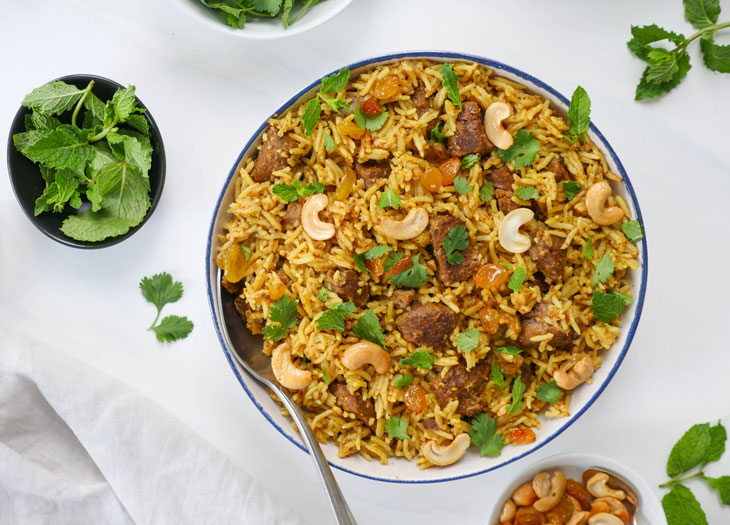
Majestic layers of saffron-kissed basmati rice and slow-braised spiced lamb, sealed and steamed together until every grain is perfumed with cardamom, cinnamon, and rose. When the pot is unsealed at the table, the aromatic cloud that escapes is nothing short of intoxicating.
Nutrition & Info
Allergen Warnings
Equipment Needed
Presentation Guide
Vessel: large serving dish, layered
Garnishes: fried onions, fresh mint, saffron strands
Accompaniments: raita, mirchi ka salan
Instructions
-
1
Marinate the lamb with yogurt, ginger-garlic paste, biryani masala, turmeric, salt, half the fried onions, and half the fresh herbs. Let rest for at least 1 hour.
-
2
Par-boil the soaked and drained rice in a large pot of salted water with whole spices (cardamom, cloves, cinnamon, bay leaves) until 70% cooked. Each grain should be firm with a white core. Drain immediately.
-
3
In a heavy-bottomed pot (degchi), heat ghee and sear the marinated lamb pieces until browned. Add the green chilies and cook the lamb with its marinade for 20 minutes over medium heat until the meat is nearly tender.
-
4
Layer the par-boiled rice over the lamb. Sprinkle the remaining fried onions, fresh mint, cilantro, saffron milk, and rosewater over the rice.
-
5
Seal the pot with aluminum foil and then a tight-fitting lid to trap every wisp of steam. Cook on high heat for 3 minutes to build steam, then reduce to the lowest possible heat and cook for 25-30 minutes (dum).
-
6
Do not open the lid during cooking. The steam trapped inside finishes cooking the rice and lamb simultaneously, infusing every grain with the spiced lamb juices.
-
7
When ready, remove lid at the table for the dramatic reveal. Gently fold the layers together with a flat spatula, being careful not to break the rice grains. Serve with raita, salan gravy, and pickled onions.
Did You Know?
The 'dum' cooking technique used in biryani dates back to the Mughal era. Legend says it was invented when Nawab Asaf-ud-Daulah of Lucknow ordered huge pots of rice and meat to feed workers building the Bara Imambara, and the sealed-pot method was born from necessity.
Chef's Notes
Equipment Tips
- heavy pot with tight lid (handi)
- mixing bowl
- sharp knife
Garnishing
fried onions, fresh mint, saffron strands
Accompaniments
raita, mirchi ka salan
The Story Behind Gosht Biryani
Biryani developed in the royal kitchens of the Mughal Empire during the reign of Emperor Akbar (1556-1605), blending Persian pilau techniques with South Asian spiced rice traditions. The word derives from the Persian 'birinj biryan' meaning 'fried rice.' Some historians argue it arrived earlier with Muslim traders and soldiers to the Deccan region. Hyderabadi biryani, developed in the kitchens of the Nizam, is among the most famous regional variants. The dish was expensive and elaborate, associated with royalty and celebration, but over centuries spread to become beloved across all social classes.
Biryani is a microcosm of India's cultural history, embodying the fusion of Mughal Persian refinement with indigenous South Asian flavors. Every major city claims its version is supreme: Hyderabadi kacchi biryani (raw marinated meat cooked with rice), Lucknowi biryani (meat par-cooked separately), Kolkata biryani (with potatoes, added by the exiled Nawab of Awadh), and Malabar biryani (with short-grain rice). The dish transcends religious and regional boundaries, beloved by Hindus, Muslims, Christians, and Sikhs alike.

Comments (0)
Log in to leave a comment.
No comments yet. Be the first to share your thoughts!