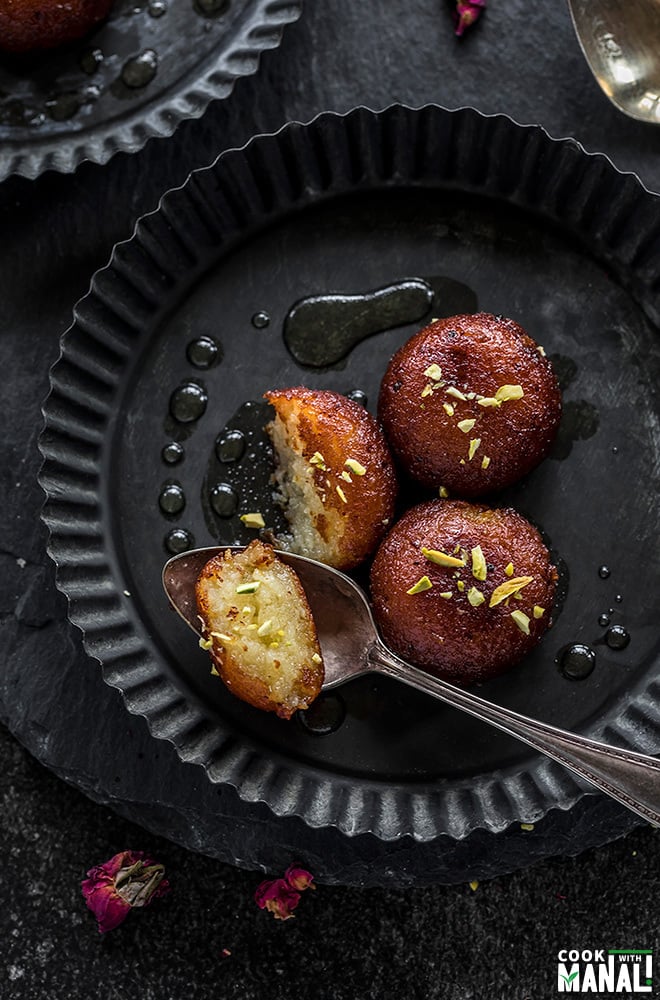
Impossibly soft, spongy spheres of milk solids and flour, deep-fried to a burnished mahogany and soaked in rose-and-cardamom-scented sugar syrup until they double in size with absorbed sweetness. One bite and they practically dissolve on the tongue in a warm, perfumed flood of pure pleasure.
Nutrition & Info
Allergen Warnings
Equipment Needed
Presentation Guide
Vessel: small decorative bowl
Garnishes: crushed pistachios, saffron strands, rose petals
Accompaniments: warm sugar syrup
Instructions
-
1
Prepare the sugar syrup first by dissolving sugar in water over medium heat. Add the crushed cardamom pods and simmer for eight minutes until slightly sticky. Remove from heat, stir in rose water and saffron, and set aside to stay warm while you prepare the dough.
-
2
Combine the milk powder, flour, and baking soda in a bowl. Add the softened ghee and rub it into the dry ingredients with your fingertips until the mixture resembles fine breadcrumbs. Add milk one tablespoon at a time, mixing gently until a soft dough forms.
-
3
Knead the dough very lightly for just one minute. Over-kneading develops gluten and produces hard gulab jamuns instead of soft, melt-in-your-mouth ones. The dough should be smooth, slightly oily, and crack-free when you roll it between your palms.
-
4
Divide the dough into twenty small portions and roll each into a perfectly smooth ball with no visible cracks on the surface. Any cracks will cause the balls to split open during frying. If the dough feels dry, moisten your palms with a drop of milk.
-
5
Heat oil or ghee in a deep pan to one hundred and twenty degrees Celsius, which is lower than typical frying temperature. Fry the balls in small batches, turning constantly with a slotted spoon for eight to ten minutes until they are uniformly deep reddish-brown all over.
-
6
Transfer the hot fried balls directly into the warm sugar syrup. Let them soak for at least two hours, during which they will absorb the cardamom and rose-scented syrup and expand to nearly double their fried size, becoming soft and spongy throughout.
-
7
Serve the gulab jamun warm or at room temperature in small bowls with generous spoonfuls of the fragrant syrup. Garnish with crushed pistachios and dried rose petals. These beloved Pakistani sweets are indispensable at celebrations, weddings, and festive gatherings.
Did You Know?
Gulab jamun derives its name from the Persian words 'gulab' (rosewater) and 'jamun' (a dark berry it resembles). It is so beloved in South Asia that it was once voted Pakistan's national dessert, despite being equally claimed by India.
Chef's Notes
Equipment Tips
- deep frying pan
- saucepan
- mixing bowl
Garnishing
crushed pistachios, saffron strands, rose petals
Accompaniments
warm sugar syrup
The Story Behind Gulab Jamun
### The Story
Gulab jamun arrived in India through Mughal influence, with roots tracing to medieval Persia. Food anthropologist Kurush F. Dalal attributes its introduction to Humayun, the second Mughal emperor, who fled to Persia in 1540 after military defeat and brought back the sweet when he returned in 1555. The name combines the Persian words gul (flower) and ab (water), referring to the rose water-scented syrup, while jamun refers to the Java plum, an Indian fruit of similar size and shape. In India, the original fried dough balls were transformed using khoya (reduced milk solids), creating a richer, creamier confection than its Persian ancestor.
### On the Calendar
Gulab jamun is essential at Diwali, Eid, Holi, and wedding celebrations. It is also one of the most popular everyday sweets sold at mithai shops across India.
### Then & Now
The basic preparation has changed little over centuries -- balls of khoya dough are deep-fried to a dark golden brown and soaked in cardamom- and rose water-scented sugar syrup. Modern variations include stuffed versions with nuts, and even frozen gulab jamun desserts.
### Legacy
Gulab jamun is arguably India's most iconic sweet, a symbol of celebration and generosity that bridges the Mughal past with the present-day table.
Comments (1)
Log in to leave a comment.
This recipe is absolutely divine! The flavors are perfectly balanced.