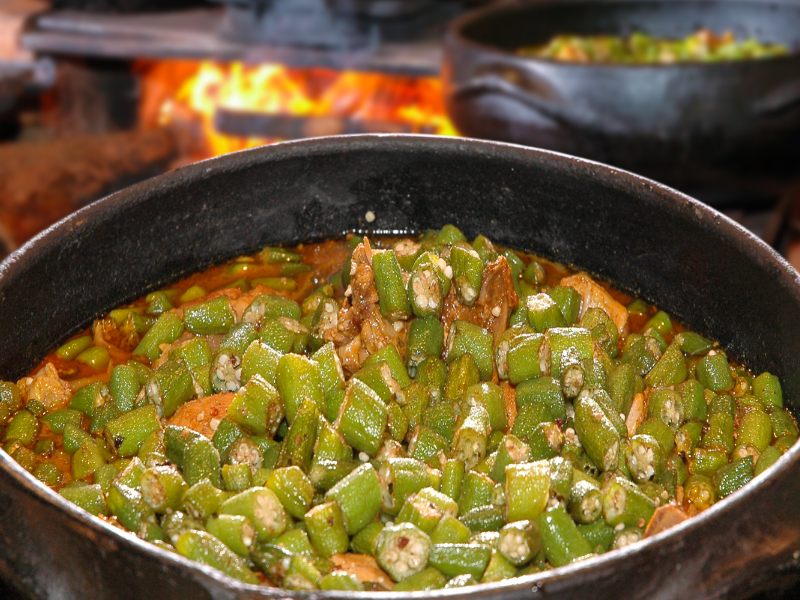
Fresh okra cooked with tomatoes and bicarbonate of soda to enhance its natural mucilaginous texture, traditionally eaten with sadza using bare hands.
Nutrition & Info
Equipment Needed
Presentation Guide
Instructions
-
1
Wash and slice okra into thin rounds, about half a centimetre thick, discarding the stem tops.
-
2
Heat oil in a pot, sauté onions until softened, about four minutes over medium heat.
-
3
Add tomatoes and cook until broken down into a sauce, roughly five minutes.
-
4
Add sliced okra, water, and bicarbonate of soda, stirring to combine everything evenly.
-
5
Cover and simmer for ten to twelve minutes, stirring occasionally, until okra is very tender and slimy.
-
6
Season with salt and serve with sadza. The slimy texture is intentional and helps the sadza slide down.
Did You Know?
The slimy texture of derere, which might surprise outsiders, is specifically cultivated and considered essential for the proper eating experience with sadza.
Chef's Notes
The Story Behind Derere
Derere is one of the most traditional Zimbabwean vegetable dishes, valued precisely for the mucilaginous quality that many Western palates find unusual. The addition of bicarbonate of soda to enhance sliminess is a uniquely Zimbabwean technique that reflects how different cultures develop opposite aesthetic preferences in food texture. Okra has been cultivated in southern Africa for centuries, and derere represents an unbroken line of culinary tradition from pre-colonial Zimbabwe.



Comments (0)
Log in to leave a comment.
No comments yet. Be the first to share your thoughts!