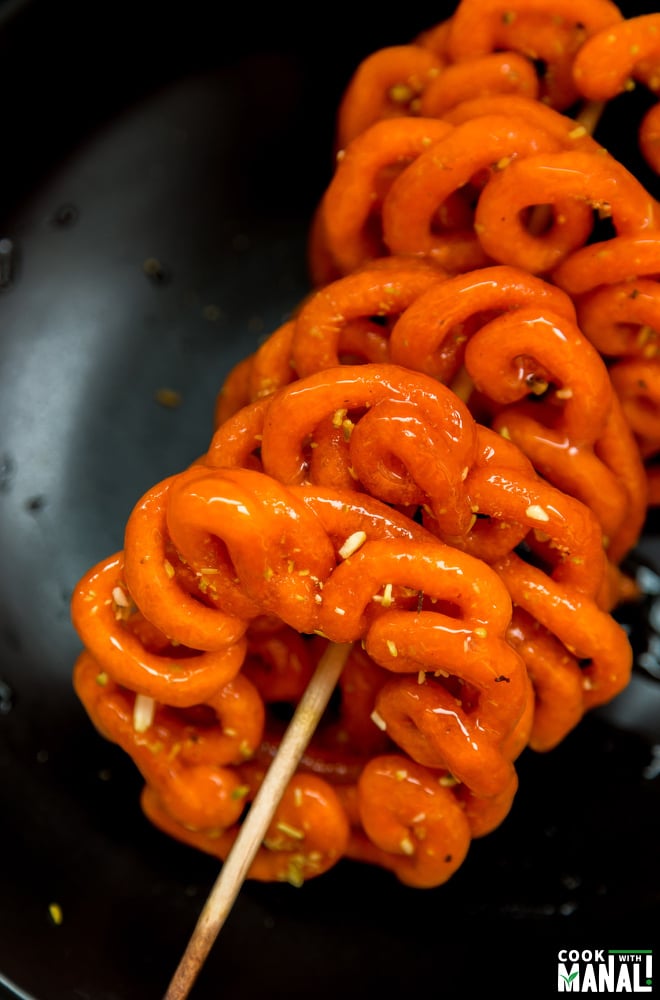
Crispy, pretzel-shaped spirals of fermented batter deep-fried and immediately dunked in saffron sugar syrup. They emerge glistening, crunchy outside and syrup-soaked inside.
Nutrition & Info
Allergen Warnings
Equipment Needed
Presentation Guide
Vessel: plate or tray
Garnishes: saffron strands, crushed pistachios
Accompaniments: rabri (thickened milk)
Instructions
-
1
Make the sugar syrup by dissolving sugar in water over medium heat, adding lemon juice to prevent crystallization. Boil for seven minutes until it reaches a one-string consistency. Add cardamom powder and rose water, then keep warm. The syrup must not be too thick or too thin.
-
2
Combine the flour, cornstarch, and baking soda in a bowl. Add the yogurt, saffron milk, and warm water. Whisk vigorously until a smooth, flowing batter forms with no lumps. The consistency should be like heavy cream, flowing freely from a spoon in a thin stream.
-
3
Cover the batter and let it ferment at room temperature for eight to twelve hours, or overnight. The fermentation creates tiny bubbles that give jalebi their characteristic crispy, porous texture. The batter should look slightly bubbly and smell mildly tangy.
-
4
Pour the fermented batter into a squeeze bottle or piping bag with a small round tip. Heat oil or ghee in a wide, shallow pan to 175C. The oil should be about three centimetres deep and the pan wide enough to form the spiral shapes.
-
5
Squeeze the batter into the hot oil in tight concentric circles, creating spiral shapes about eight centimetres in diameter. Fry for one to two minutes per side until deep golden and very crispy, turning once. The jalebis should be thoroughly crisp with no soft spots.
-
6
Remove the crispy jalebis from the oil and immediately submerge them in the warm sugar syrup for thirty seconds, turning once so both sides absorb the syrup. The hot, porous jalebis will soak up the syrup instantly, becoming sweet and juicy while maintaining their crunch.
-
7
Lift the jalebis from the syrup and serve immediately while still warm and crispy on the outside with syrup-soaked centres. The contrast between the shattering exterior and the sweet, syrupy interior is what makes fresh jalebi irresistible.
Did You Know?
Jalebi is believed to have originated in Persia as 'zolbia' and traveled along trade routes to South Asia, where it became a beloved street sweet.
Chef's Notes
Equipment Tips
- deep frying pan
- squeeze bottle or piping bag
- saucepan
Garnishing
saffron strands, crushed pistachios
Accompaniments
rabri (thickened milk)
The Story Behind Jalebi
### The Story
Jalebi's earliest known recipe appears in the 10th-century Arabic cookbook Kitab al-Tabikh by Ibn Sayyar al-Warraq, where it is described as zulabiya, a fried batter soaked in honey syrup. The sweet traveled eastward through Persian and Turkic culinary networks, arriving in the Indian subcontinent where it was documented in a Jain text around 1450 CE under the name jallavallika. Another Sanskrit text before 1600 CE provides a full recipe. In Pakistan, jalebi became deeply embedded in street food culture, with halwai (sweet-maker) shops frying the bright orange spirals in enormous kadhai pans, dipping them in sugar syrup, and serving them crispy and warm.
### On the Calendar
Jalebi is served year-round but is especially associated with Ramadan iftar, Eid celebrations, and Basant (spring festival). It is a common breakfast item, often paired with warm milk or rabri (thickened sweetened milk).
### Then & Now
The basic technique has changed little over a millennium: fermented batter is piped through a cloth or squeeze bottle into hot oil in circular, pretzel-like shapes, fried until crisp, and immediately dunked in sugar syrup. The contrast of crunchy exterior and syrupy interior defines the experience. Modern variations include rabri-filled jalebi and chhena (fresh cheese) jalebi, but the classic remains supreme. In Pakistan, the bright orange coils stacked in gleaming pyramids at halwai shops are an iconic urban sight.
### Legacy
Jalebi is a sweet that has traveled from medieval Baghdad to the streets of Lahore and Karachi, its spiral shape tracing an unbroken thread of culinary exchange across a thousand years of Islamic civilization.

Comments (0)
Log in to leave a comment.
No comments yet. Be the first to share your thoughts!