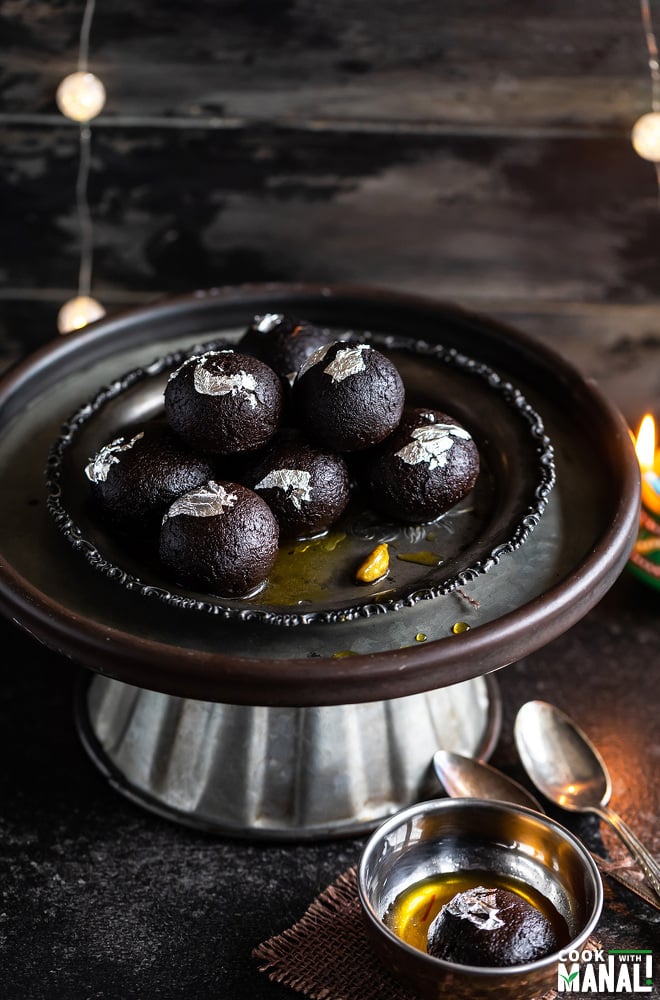
Soft, spongy milk-solid dumplings deep-fried until mahogany brown, then soaked in cardamom and rose-scented sugar syrup until they become pillowy clouds of sweetness.
Nutrition & Info
Allergen Warnings
Equipment Needed
Presentation Guide
Vessel: small decorative bowl
Garnishes: crushed pistachios, saffron strands, rose petals
Accompaniments: warm sugar syrup
Instructions
-
1
Make the sugar syrup first by dissolving sugar in water over medium heat. Add the cardamom pods and saffron. Bring to a boil, then simmer for eight minutes until slightly thickened. Add rose water, remove from heat, and keep warm. The syrup must be warm when the fried balls are soaked.
-
2
Combine the milk powder, flour, and baking soda in a bowl. Add the softened ghee and rub it into the dry ingredients with your fingertips until the mixture resembles breadcrumbs. Gradually add the milk, one tablespoon at a time, mixing gently.
-
3
Knead very gently into a soft, smooth dough. Do not overwork the dough or the gulab jamun will be hard and dense rather than melt-in-your-mouth soft. The dough should be slightly sticky and come together easily without cracking at the edges.
-
4
Divide the dough into sixteen equal pieces and roll each between your palms into perfectly smooth balls with no cracks on the surface. Any cracks will cause the balls to split open during frying. If cracks appear, add a tiny drop of milk and re-roll.
-
5
Heat oil or ghee for deep-frying to 130C, which is lower than typical frying temperatures. This low heat is essential so the gulab jamun cook through to the centre without burning on the outside. Fry in batches of four, turning constantly for even browning.
-
6
Fry for seven to eight minutes, turning very frequently with a slotted spoon, until the balls are uniformly deep brown on all sides. They will expand slightly during frying. Remove and immediately place into the warm sugar syrup.
-
7
Let the gulab jamun soak in the warm syrup for at least two hours, turning occasionally so they absorb syrup evenly and swell to nearly double their fried size. Serve warm or at room temperature, garnished with chopped pistachios and a spoonful of the fragrant syrup.
Did You Know?
The secret to perfect gulab jamun is frying at low temperature — if the oil is too hot, they'll be dark outside but raw inside.
Chef's Notes
Equipment Tips
- deep frying pan
- saucepan
- mixing bowl
Garnishing
crushed pistachios, saffron strands, rose petals
Accompaniments
warm sugar syrup
The Story Behind Gulab Jamun
### The Story
Gulab jamun emerged during the Mughal Empire in medieval India, blending Persian influence with South Asian confectionery traditions. The sweet evolved from a Central Asian-Turkic fritter made from refined flour dipped in sugar syrup, brought to the subcontinent by Turkic invaders. The name combines the Persian words gul (flower) and ab (water), referring to the rose water-scented syrup, with jamun being the Hindustani word for a similarly shaped Indian berry. The defining ingredient, khoya (milk reduced to a soft dough), represents the subcontinent's own contribution, transforming a simple fritter into a dense, aromatic sphere.
### On the Calendar
Gulab jamun is served at every major Pakistani celebration: Eid al-Fitr, Eid al-Adha, weddings, and Shab-e-Barat. It is also a year-round restaurant dessert and a common offering during Ramadan.
### Then & Now
Traditional gulab jamun is made from khoya kneaded with a small amount of flour, shaped into balls, deep-fried at low temperature until deep mahogany brown, and soaked in a light sugar syrup perfumed with rose water and green cardamom. Modern shortcuts use milk powder in place of khoya, and ready-made mixes have made the dessert accessible worldwide. Gourmet versions include stuffings of nuts or saffron cream.
### Legacy
Gulab jamun is the sweet jewel of Mughal culinary heritage -- a rose-scented sphere that embodies the refinement of Persian-South Asian fusion confectionery.

Comments (0)
Log in to leave a comment.
No comments yet. Be the first to share your thoughts!