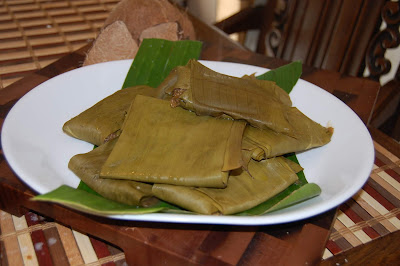
Grated taro, yam, or banana mixed with coconut cream, wrapped in banana leaves and baked. Vanuatu's national dish.
Nutrition & Info
Allergen Warnings
Equipment Needed
Presentation Guide
Instructions
-
1
Peel the root vegetable and grate it finely using a traditional coral grater or the finest holes of a box grater. The gratings should be pulpy and wet, almost a paste. Squeeze out some excess liquid, reserving it, until the mixture has the consistency of thick porridge.
-
2
Season the grated root vegetable with salt and mix in the diced onion. If adding protein, fold the shredded chicken or fish into the mixture, distributing it evenly so every portion contains some meat or fish throughout.
-
3
Soften the banana leaves by passing them briefly over an open flame or blanching in boiling water. Lay several overlapping leaves on a flat surface to create a large rectangular platform big enough to hold all the mixture with room to fold over.
-
4
Spread the seasoned root vegetable mixture evenly over the banana leaves in a layer about three centimetres thick. Pour the coconut cream evenly over the top, allowing it to soak into the mixture and pool slightly around the edges.
-
5
Fold the banana leaves up and over the mixture from all sides to create a sealed flat package. Tie securely with string or strips of banana leaf. Traditionally this goes onto hot stones in an earth oven; for home cooking, place on a baking tray.
-
6
Cook in a preheated oven at 190C for one hour, or in an earth oven on hot stones for the same duration, until the laplap is firm and set. The coconut cream should have been absorbed and the surface should be lightly golden where exposed.
-
7
Unwrap the banana leaves carefully at the table. The finished laplap should be firm enough to cut into slices, with a starchy, slightly sweet flavour from the root vegetable complemented by the richness of the coconut cream. Serve hot as a main course.
Did You Know?
Laplap is always present at custom ceremonies and is considered Vanuatu's most important cultural food.
Chef's Notes
Equipment Tips
- grater
- banana leaves
- earth oven or conventional oven
Garnishing
coconut cream
Accompaniments
The Story Behind Laplap
The Story: Laplap is the national dish of Vanuatu, a dense, starchy pudding made by grating taro, yam, manioc, or breadfruit into a paste, spreading it on banana leaves, layering it with coconut cream and sometimes meat or fish, wrapping the package tightly, and cooking it in an earth oven (umu) for hours until the starch solidifies into a thick, cohesive slab. The specific root crop used determines the variety: laplap taro, laplap yam, or laplap manioc, each with a distinct texture and flavor. The dish is ancient, predating any European contact by millennia.
On the Calendar: Laplap is both everyday food and celebration food, with the elaborateness of the preparation scaling to the occasion. Simple versions might be prepared for family meals, while grand feasts feature enormous laplap made from the finest ingredients and served to the entire community.
Then & Now: Laplap remains central to Ni-Vanuatu food culture, though daily preparation has become less common in urban Port Vila, where rice and bread are more convenient. For celebrations, cultural events, and village life, laplap retains its supreme position as the dish that defines Ni-Vanuatu identity.
Legacy: Laplap is Vanuatu's culinary foundation stone, a dish that connects modern islanders to three thousand years of Melanesian root crop civilization and earth oven mastery.
Comments (0)
Log in to leave a comment.
No comments yet. Be the first to share your thoughts!