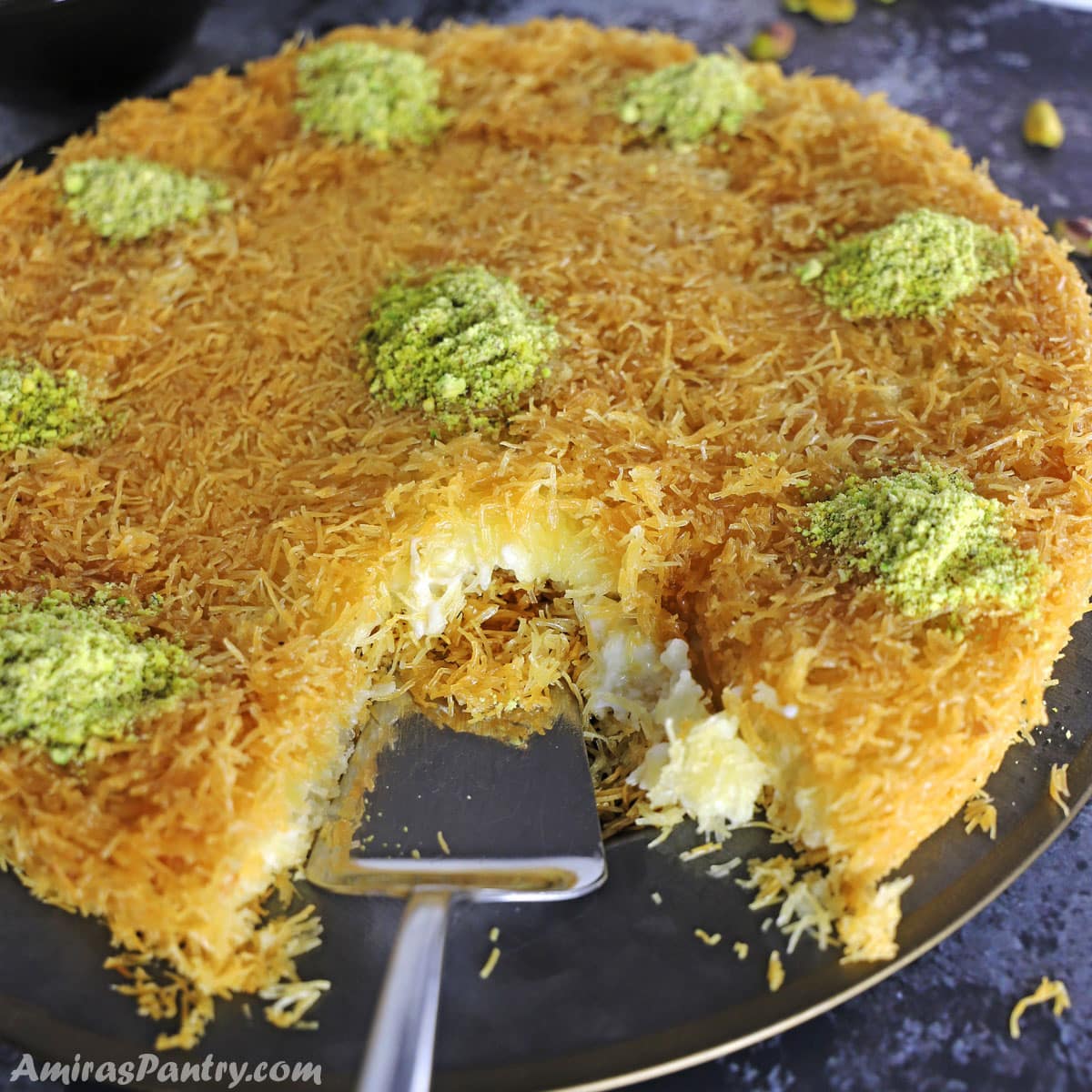
Shredded phyllo layered over stretchy melted cheese, soaked in rose-scented syrup and crowned with crushed pistachios. The warm cheese pull beneath crispy golden top is pure magic.
Nutrition & Info
Allergen Warnings
Equipment Needed
Presentation Guide
Vessel: inverted onto round platter
Garnishes: crushed pistachios, orange blossom syrup drizzle
Instructions
-
1
Prepare the sugar syrup first: combine the sugar and water in a saucepan over medium heat, stirring until dissolved. Add the lemon juice, bring to a boil, and simmer for eight minutes until slightly thickened. Stir in the rose water and orange blossom water, then cool completely.
-
2
Drain the soaked akkawi cheese and taste it to ensure most of the salt has been removed. If still salty, soak for another hour in fresh water. Shred or crumble the akkawi, then combine it with the shredded mozzarella in a bowl.
-
3
Place the thawed kataifi pastry in a large bowl and gently separate and loosen the shredded strands with your fingers. Pour the melted butter over the pastry and work it through with your hands until every strand is evenly coated.
-
4
Press half of the buttered kataifi into the bottom of a round 25cm baking pan, creating a firm, even layer that extends slightly up the sides. Pack it down firmly with your hands or the bottom of a flat glass.
-
5
Spread the combined cheese mixture evenly over the pastry base, pressing it into a flat, uniform layer. Top with the remaining kataifi pastry, pressing down firmly again to compress all the layers into compact contact with each other.
-
6
Bake in a preheated 180°C oven for thirty-five to forty minutes until the top and edges are a deep, rich golden brown and you can hear the cheese gently sizzling beneath the crispy pastry shell.
-
7
Remove from the oven and immediately pour the cooled sugar syrup evenly over the entire surface. The hot pastry will absorb the syrup with a dramatic sizzle. Let it rest for two minutes, then invert the knafeh onto a serving platter.
-
8
Sprinkle the crushed pistachios generously over the top of the inverted knafeh while it is still warm and sticky. Slice into wedges or squares and serve immediately, pulling apart the stretchy cheese centre for a dramatic presentation.
Did You Know?
Nablus in Palestine is considered the birthplace of knafeh.
Chef's Notes
Equipment Tips
- round baking tray
- saucepan for syrup
- oven
Garnishing
crushed pistachios, orange blossom syrup drizzle
The Story Behind كنافة
## The Story
Knafeh is a beloved Levantine pastry with disputed origins stretching across centuries. Some trace it to the Umayyad dynasty, when it was eaten as a filling suhoor meal before Ramadan fasting in Damascus. Others attribute its origins to 15th-century Egypt. A 13th-century Maghrebi-Andalusian cookbook provides multiple recipes for knafeh, describing it as a thin pancake dumpling. The city of Nablus in Palestine is most closely associated with the definitive cheese-filled version.
## On the Calendar
Knafeh is especially associated with Ramadan, served as a suhoor dish and as a celebratory dessert during Eid al-Fitr. In Lebanon, the semolina-based knefeh bi-jibn is a popular breakfast pastry, often eaten with an orange blossom syrup drizzle.
## Then & Now
The Lebanese version, knefeh na'ameh, uses semolina dough rather than shredded phyllo (knafeh nabilsiyeh), giving it a cake-like texture. It is filled with mozzarella or akkawi cheese and soaked in orange blossom syrup. Once a Ramadan specialty, it is now enjoyed year-round from Beirut bakeries to global Lebanese restaurants.
## Legacy
Knafeh represents the sweet heart of Levantine hospitality, a pastry that transcends borders and binds communities across Lebanon, Palestine, Syria, and Jordan in shared tradition.


Comments (0)
Log in to leave a comment.
No comments yet. Be the first to share your thoughts!