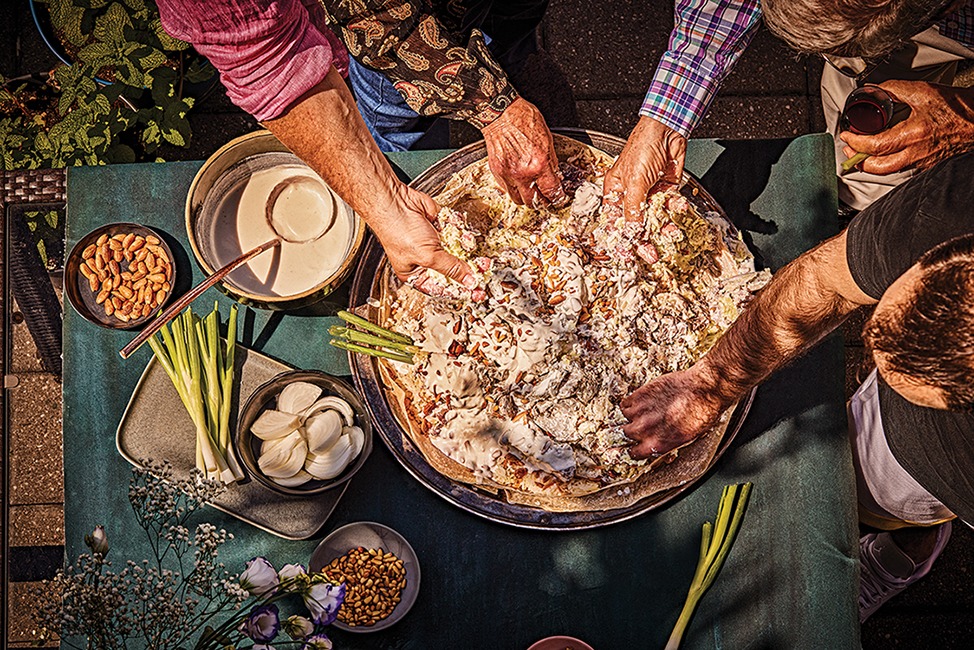
Jordan's majestic national dish — tender lamb in fermented yogurt sauce (jameed), over saffron rice and shrak bread. Eaten with the right hand.
Nutrition & Info
Allergen Warnings
Equipment Needed
Presentation Guide
Vessel: large communal platter lined with flatbread
Garnishes: toasted almonds, pine nuts, fresh parsley
Accompaniments: jameed sauce, flatbread
Instructions
-
1
Crush the dried jameed balls and soak them overnight in four cups of warm water. The following day, blend the mixture until completely smooth, then strain through a fine sieve to remove any remaining lumps.
-
2
Place the lamb pieces in a large pot, cover with cold water by five centimetres, and bring to a boil. Skim off all foam, then add the cardamom pods, quartered onion, bay leaves, and salt. Simmer for two hours until very tender.
-
3
Remove the cooked lamb from the broth and set aside, keeping it covered. Strain the broth through a fine sieve and reserve four cups for cooking the rice and additional broth for thinning the jameed sauce.
-
4
Pour the blended jameed into a separate pot, stir in one cup of the reserved lamb broth, and bring to a gentle simmer over medium-low heat, stirring constantly in one direction to prevent the sauce from separating.
-
5
Add the cooked lamb pieces to the simmering jameed sauce and cook together for twenty minutes, allowing the meat to absorb the tangy yogurt flavour while the sauce thickens slightly.
-
6
Cook the rinsed rice in the reserved lamb broth with the saffron water and a tablespoon of ghee. Bring to a boil, reduce to low heat, cover tightly, and steam for eighteen minutes until each grain is fluffy and separate.
-
7
Heat the remaining ghee in a small pan and toast the almonds and pine nuts, stirring frequently, until they turn a deep golden colour, about three to four minutes. Remove immediately to prevent burning.
-
8
Tear the shrak bread into large pieces and arrange across a wide serving platter. Ladle a few spoonfuls of jameed sauce over the bread, then mound the saffron rice on top and arrange the lamb pieces over the rice.
-
9
Pour additional warm jameed sauce generously over the entire platter, scatter the toasted nuts on top, and serve immediately, encouraging guests to eat communally with their right hand in the traditional Bedouin style.
Did You Know?
Mansaf is eaten standing around a platter using only the right hand — the left stays behind your back.
Chef's Notes
Equipment Tips
- large pot
- serving platter
- ladle
Garnishing
toasted almonds, pine nuts, fresh parsley
Accompaniments
jameed sauce, flatbread
The Story Behind منسف
### The Story
Mansaf is the undisputed national dish of Jordan and the supreme expression of Bedouin hospitality. The dish consists of tender lamb cooked in a fermented dried yogurt sauce called jameed, served over a bed of rice and thin shrak bread, garnished with toasted almonds and pine nuts. Mansaf's origins lie deep in Bedouin tradition, where slaughtering a lamb for an honored guest was the highest act of generosity. The use of jameed -- yogurt dried into hard balls that are reconstituted into a tangy, savory sauce -- was a practical innovation by nomadic herders who needed to preserve dairy products in the desert heat. The word mansaf means "large tray," referring to the communal platter from which the dish is traditionally eaten.
### On the Calendar
Mansaf is served at every important life event in Jordanian culture -- weddings, funerals, religious holidays, the resolution of tribal disputes, and the welcoming of important guests. It is the obligatory dish at national celebrations and royal occasions.
### Then & Now
Traditional mansaf etiquette requires eating while standing around the communal tray, using only the right hand to form balls of rice and meat. The jameed sauce is the dish's soul -- it must be simmered carefully to prevent curdling and seasoned with turmeric and aromatic spices. While modern Jordanians sometimes eat mansaf seated at tables with utensils, the traditional standing communal style remains the standard for formal occasions.
### Legacy
Mansaf is far more than food in Jordan -- it is a social institution, a ritual of unity and respect that binds communities together and defines what it means to be Jordanian.



Comments (0)
Log in to leave a comment.
No comments yet. Be the first to share your thoughts!