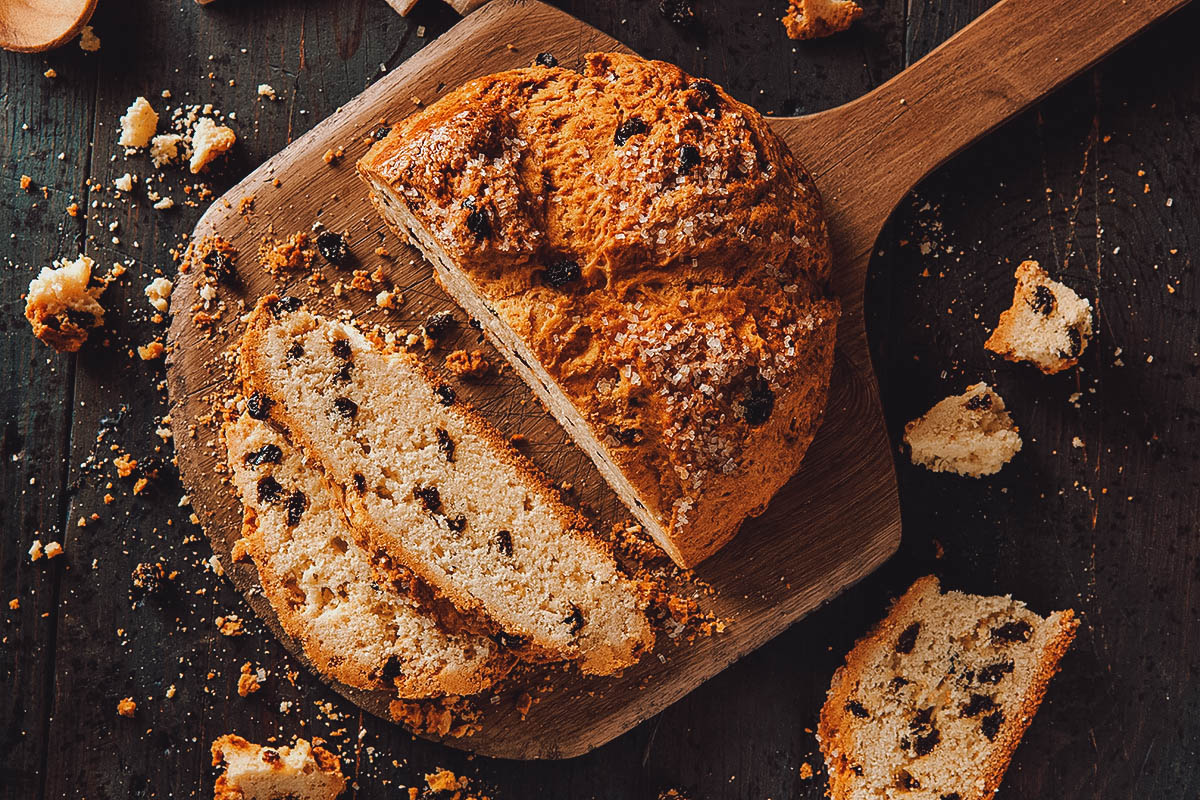
A rustic, crusty bread leavened with baking soda and buttermilk instead of yeast. Ready in under an hour.
Instructions
-
1
Preheat the oven to two hundred degrees Celsius and lightly dust a large baking tray with flour. Sift the flour, bicarbonate of soda, and salt into a large mixing bowl, lifting the sieve high to aerate the flour as it falls.
-
2
Make a wide well in the centre of the dry ingredients and pour in the buttermilk in one go. Using a wooden spoon or your hand in a claw shape, stir from the centre outward in quick, circular motions to bring the dough together.
-
3
The dough should come together into a soft, slightly sticky mass within thirty seconds of mixing. Stop as soon as there is no dry flour remaining — overworking the dough develops gluten and produces a tough, dense loaf.
-
4
Turn the dough out onto a lightly floured surface and shape it gently into a round about five centimetres thick. Do not knead; simply pat and turn the dough two or three times to form a smooth-topped boule.
-
5
Transfer the round to the prepared baking tray and use a sharp, floured knife to cut a deep cross across the top, slashing almost to the base. This traditional scoring allows heat to penetrate the centre and helps the bread rise evenly.
-
6
Bake for fifteen minutes at two hundred degrees, then reduce the oven temperature to one hundred and eighty degrees and bake for another twenty to twenty-five minutes until the crust is deeply golden and the loaf sounds hollow when tapped on the base.
-
7
Allow the soda bread to cool on a wire rack for at least fifteen minutes before slicing. Serve warm with salted butter, a good Irish cheddar, or alongside a hearty soup or stew.
Did You Know?
The cross cut into soda bread was traditionally to 'let the devil out' and help the bread bake evenly.
The Story Behind Irish Soda Bread
The Story: Irish Soda Bread is a quick bread leavened with bicarbonate of soda (baking soda) activated by buttermilk rather than yeast, producing a dense, tender loaf with a distinctive cross scored on top. The bread emerged in the 1830s and 1840s when bicarbonate of soda became commercially available, providing Irish rural households with a leavening agent that worked perfectly with the soft wheat flour and abundant buttermilk available in Ireland. Unlike yeast breads, soda bread requires no kneading or rising time, making it practical for busy farmhouse kitchens with limited fuel and equipment.
On the Calendar: Soda bread is baked daily in traditional Irish households, served fresh at every meal. It is essential to the Irish breakfast table and serves as the bread accompaniment to soups, stews, and smoked salmon.
Then & Now: The traditional recipe of flour, buttermilk, salt, and soda remains unchanged, though modern variations incorporate raisins (spotted dog), seeds, herbs, or whole grains. Artisan bakeries have elevated soda bread while maintaining its essential simplicity.
Legacy: Irish Soda Bread is the most democratic of breads, requiring no special equipment, no time, and no skill beyond mixing, yet producing a loaf of honest, satisfying character that has sustained Ireland for nearly two centuries.

Comments (1)
Log in to leave a comment.
Tried this for a dinner party and got so many compliments!