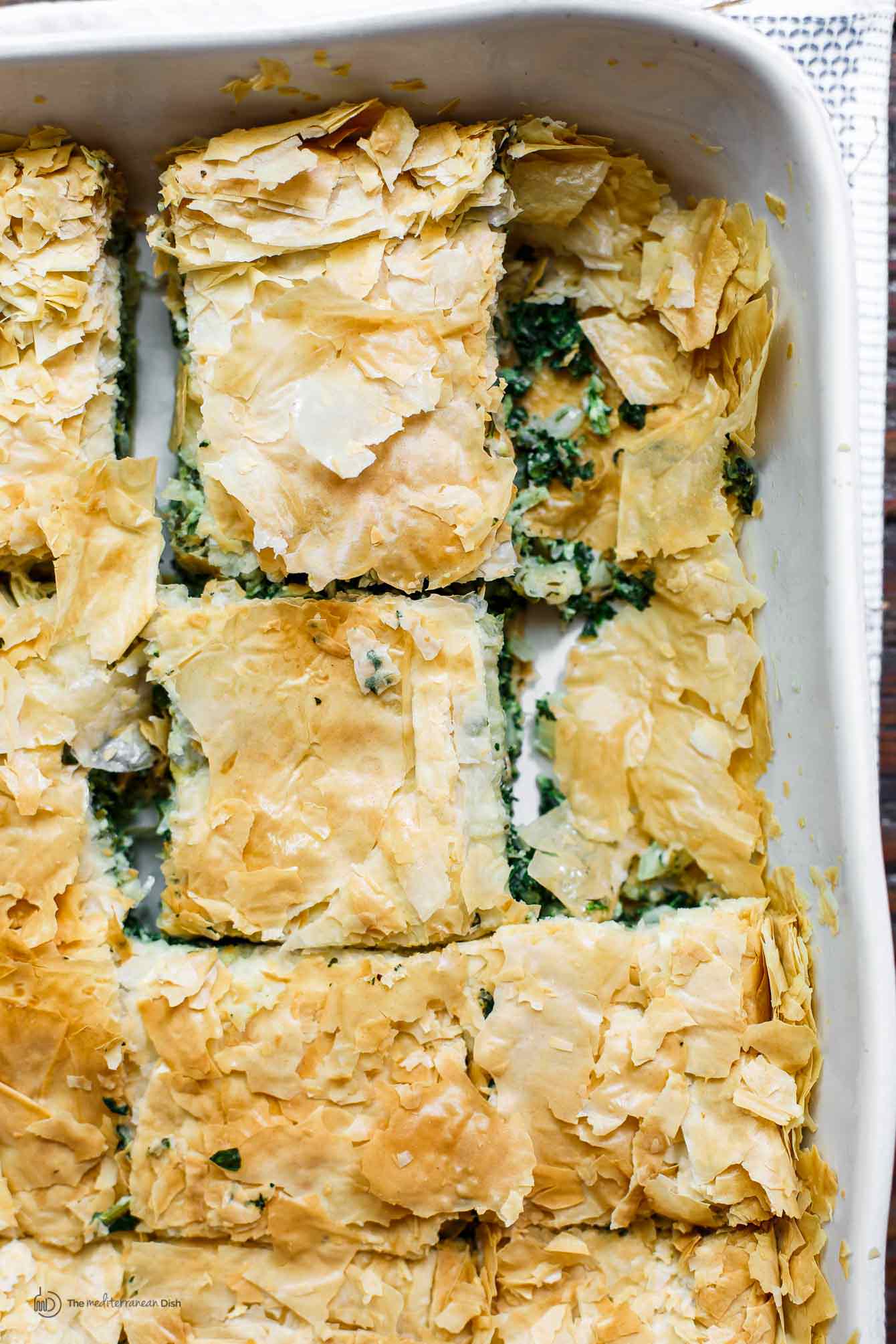
Crispy, flaky phyllo pastry encasing a savory filling of spinach, feta cheese, dill, and scallions. Each bite shatters through golden layers to reveal the vibrant green filling.
Nutrition & Info
Allergen Warnings
Equipment Needed
Presentation Guide
Vessel: triangular or square portions on plate
Garnishes: sesame seeds
Accompaniments: Greek salad, lemon wedge
Instructions
-
1
Heat two tablespoons of olive oil in a large skillet over medium heat, add the scallions, and cook for two minutes until softened before adding the chopped spinach in batches, stirring until fully wilted.
-
2
Transfer the wilted spinach to a colander set over a bowl and press firmly with the back of a spoon to squeeze out as much liquid as possible, then spread on a clean kitchen towel and wring dry.
-
3
In a large mixing bowl, combine the squeezed spinach with the crumbled feta, beaten eggs, dill, parsley, nutmeg, salt, and pepper, folding gently until all ingredients are evenly distributed throughout the filling.
-
4
Preheat the oven to 180 degrees Celsius and brush a 23-by-33-centimetre baking dish generously with olive oil, ensuring the bottom and sides are well coated to prevent the phyllo from sticking.
-
5
Lay one sheet of phyllo dough in the dish, letting any excess drape over the edges, and brush the entire surface with olive oil. Repeat with five more sheets, brushing each one before adding the next layer.
-
6
Spread the spinach and feta filling evenly over the phyllo base, pressing it down gently with a spatula to create a smooth, compact layer that reaches into all corners of the dish.
-
7
Layer the remaining six sheets of phyllo on top of the filling, brushing each sheet generously with olive oil before adding the next, then tuck any overhanging edges neatly under the pie.
-
8
Using a sharp knife, score the top layers of phyllo into squares or diamond shapes, cutting through only the top pastry layers so steam can escape during baking without disturbing the filling.
-
9
Sprinkle a few drops of cold water over the top to help prevent the phyllo edges from curling, then bake for thirty-five to forty minutes until the pastry is deeply golden and crisp throughout.
-
10
Remove from the oven and allow the spanakopita to rest for ten minutes before cutting along the scored lines and serving warm or at room temperature as a main course or appetizer.
Did You Know?
Spanakopita is the quintessential Greek comfort food. Greeks have been wrapping fillings in phyllo for over 500 years — the technique comes from Ottoman palace kitchens.
Chef's Notes
Equipment Tips
- large baking pan
- pastry brush
- mixing bowl
- oven
Garnishing
sesame seeds
Accompaniments
Greek salad, lemon wedge
The Story Behind Σπανακόπιτα
### The Story
Spanakopita descends from ancient Greek pie-making traditions that date back to at least the 5th century BCE, when the poet Philoxenos described savory pies filled with greens, herbs, and cheese. Before spinach arrived, Greeks used wild greens (horta) as the backbone of their pies. Spinach itself originated in the Middle East and reached Greece during the Byzantine era, where it married with phyllo dough -- a pastry technique refined under Ottoman influence -- to create the modern spanakopita. The dish is most celebrated in the northwestern region of Epirus, where pie-making (pitta) is elevated to an art form with dozens of regional variations.
### On the Calendar
Spanakopita is eaten year-round but holds special significance during Orthodox Lent, when it is sometimes made without cheese (spanakotiropita becomes simply spanakopita). It is also a staple of holiday tables, buffets, and family gatherings.
### Then & Now
Traditional spanakopita layers buttered sheets of handmade phyllo dough with a filling of spinach, feta cheese, dill, and scallions. Regional variations are extensive: in Epirus, the phyllo is thicker and often handmade; in Thessaloniki, the pie may be coiled into a spiral. Modern versions range from individual triangles to family-sized trays. Store-bought phyllo has made the dish more accessible, but the handmade version remains the benchmark.
### Legacy
Spanakopita represents the genius of Greek peasant cooking -- wild greens, simple cheese, and paper-thin dough transformed into something that has sustained Greek families from antiquity to the present day.
Comments (0)
Log in to leave a comment.
No comments yet. Be the first to share your thoughts!