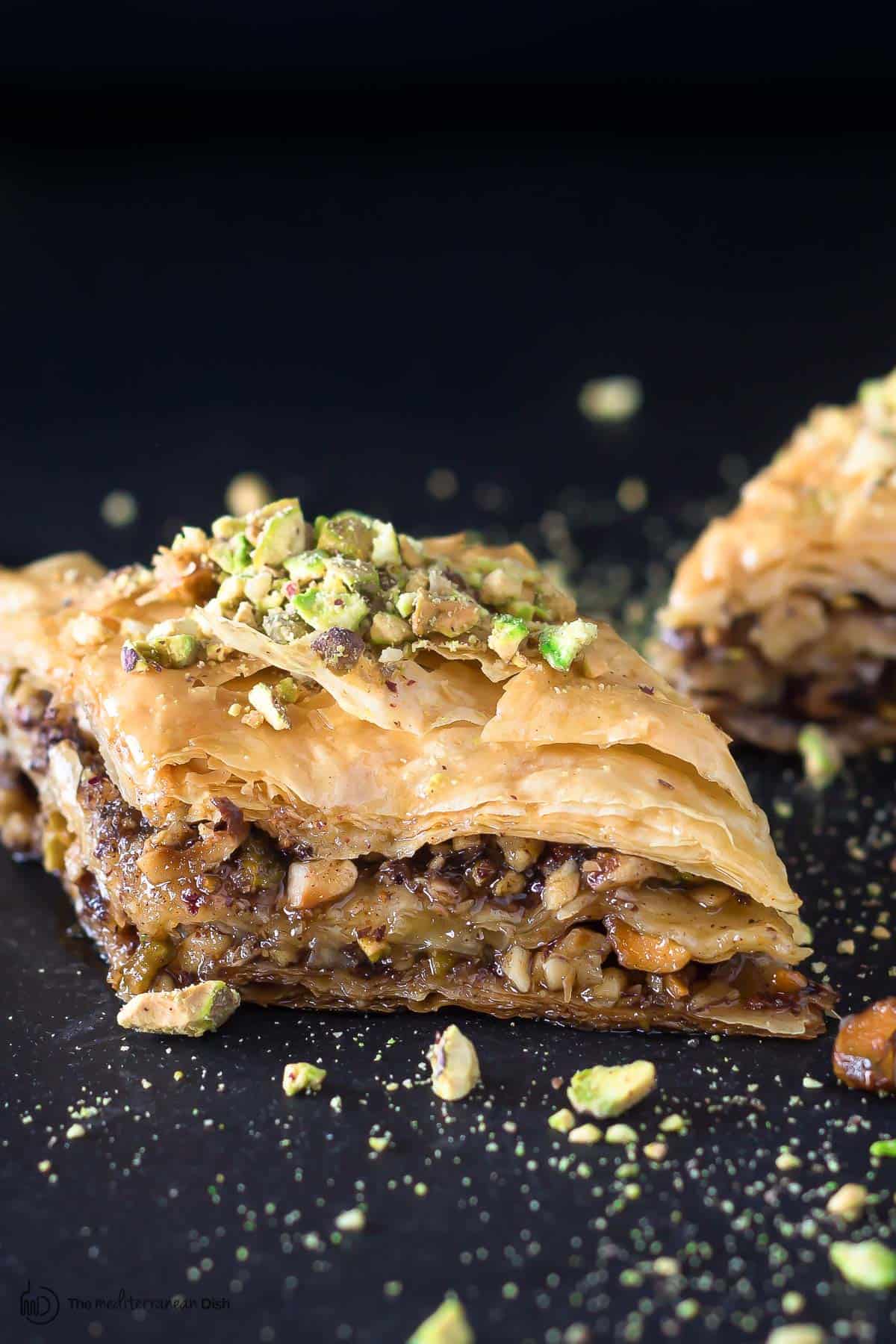
Dozens of paper-thin phyllo layers with crushed walnuts and warm spices, baked golden and drenched in honey-lemon syrup. Each piece is a flaky, nutty, syrup-soaked marvel.
Nutrition & Info
Allergen Warnings
Equipment Needed
Presentation Guide
Instructions
-
1
Make the syrup first so it can cool completely. Combine the sugar, water, honey, lemon juice, cinnamon stick, and whole cloves in a saucepan. Bring to a boil, then simmer for ten minutes until slightly thickened. Cool completely. Hot syrup on hot pastry makes it soggy.
-
2
Preheat the oven to 170C. Combine the chopped walnuts and almonds with the ground cinnamon and cloves in a bowl. Brush a 23x33cm baking pan generously with melted butter, ensuring the entire surface is well coated.
-
3
Layer eight sheets of phyllo in the pan, brushing each sheet generously with melted butter before adding the next. Keep the remaining phyllo covered with a damp towel to prevent it from drying out and becoming brittle while you work.
-
4
Spread one-third of the nut mixture evenly over the phyllo base. Layer four more buttered phyllo sheets on top, then another third of the nuts, four more buttered sheets, the remaining nuts, and finally eight more buttered phyllo sheets on top.
-
5
Using a very sharp knife, cut the baklava into diamond shapes by first cutting straight parallel lines, then cutting diagonal lines across them. Cut all the way through to the bottom of the pan. This must be done before baking.
-
6
Bake for forty-five to fifty minutes until the phyllo is deeply golden brown and crispy on top. Remove from the oven and immediately pour the completely cooled syrup evenly over the hot baklava. The contrast of hot pastry and cold syrup creates the ideal absorption.
-
7
Let the baklava sit uncovered at room temperature for at least four hours, preferably overnight, to allow the syrup to fully penetrate all the layers. The baklava should be crispy on top and syrup-soaked at the bottom. Store at room temperature, never refrigerated.
Did You Know?
The rule of baklava: always pour cold syrup over hot pastry (never the reverse). This creates the distinctive crispy-yet-syrupy texture.
Chef's Notes
Equipment Tips
- baking pan
- pastry brush
- sharp knife
- saucepan
- oven
Garnishing
chopped pistachios
Accompaniments
Greek coffee, tea
The Story Behind Μπακλαβάς
### The Story
Baklava's origins are among the most hotly contested in culinary history. Ancient precursors include the Assyrian Empire's layered flatbreads with chopped nuts (8th century BCE) and the Greco-Roman placenta cake of layered dough, cheese, and honey. The Byzantine tradition of koptoplakous -- a honeyed, layered pastry -- likely served as a bridge to the Ottoman refinement that produced modern baklava. The Ottoman imperial kitchens at Topkapi Palace perfected the dish, and the Sultan ceremonially presented trays of baklava to the Janissaries during Ramadan in a procession called the Baklava Alayi. Greek baklava distinguishes itself with a generous use of walnuts (rather than pistachios), honey syrup (rather than sugar syrup), and warm spices like cinnamon and clove.
### On the Calendar
Greek baklava is associated with celebrations, holidays, and family gatherings. It is especially prominent during Easter, Christmas, and name-day celebrations.
### Then & Now
Greek baklava remains faithful to its traditional form: dozens of layers of hand-brushed phyllo dough, filled with chopped walnuts and cinnamon, baked until golden, and soaked in honey-lemon syrup. Regional Greek variations include the Cretan version with almonds and rosewater and the Pontian version with hazelnuts. The dish remains central to Greek pastry-making, with every family claiming a superior recipe.
### Legacy
Baklava transcends national boundaries, claimed by Greeks, Turks, Arabs, and Persians alike -- yet its presence in Greek celebrations for centuries has made it an inseparable part of the Hellenic sweet table.
Comments (0)
Log in to leave a comment.
No comments yet. Be the first to share your thoughts!