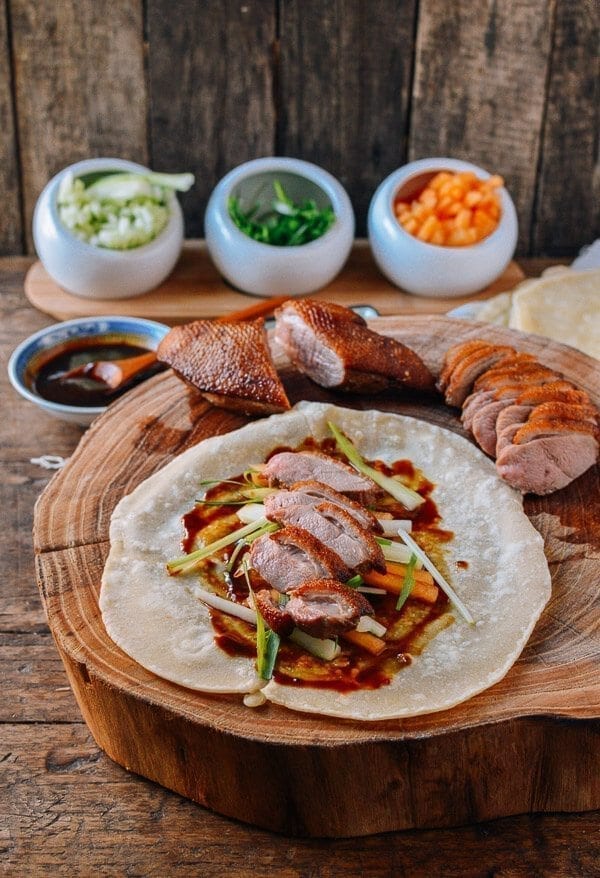
Whole duck roasted to crackling perfection with lacquered mahogany skin that shatters. Wrapped in thin pancakes with scallions and hoisin — China's most celebrated feast.
Nutrition & Info
Allergen Warnings
Equipment Needed
Presentation Guide
Vessel: carved tableside on platter
Garnishes: scallion brushes, cucumber sticks
Accompaniments: thin pancakes, hoisin sauce, scallions
Instructions
-
1
Rinse the duck thoroughly inside and out, then pat completely dry. Carefully separate the skin from the flesh by inserting a straw or pump between the skin and breast and inflating, which ensures the skin crisps evenly during roasting.
-
2
Dissolve the maltose in the boiling water, then stir in the rice vinegar and soy sauce to create the glaze. Pour this mixture over the duck repeatedly, ladling it over every surface until the skin is evenly coated.
-
3
Hang the glazed duck in a cool, well-ventilated area or place it uncovered on a rack in the refrigerator for twelve to twenty-four hours. The skin must dry completely, which is the essential step for achieving crackling crispness.
-
4
Preheat the oven to 240C. Place the duck breast-side up on a rack set over a roasting pan filled with two centimetres of water. Roast at high heat for fifteen minutes to initiate the skin crisping.
-
5
Reduce the oven temperature to 180C and continue roasting for one hour to one hour and fifteen minutes, rotating the pan halfway through. The duck is done when the skin is deeply mahogany and shatteringly crisp throughout.
-
6
Remove the duck from the oven and let it rest for ten minutes on the carving board. Using a very sharp thin knife, carefully carve the crispy skin into small rectangular pieces, keeping a thin layer of fat attached to each.
-
7
Slice the duck meat separately into thin strips. Arrange the skin pieces and meat on separate platters. Warm the Mandarin pancakes by steaming for three minutes until soft, pliable, and lightly translucent.
-
8
To assemble, spread a small amount of hoisin and sweet bean sauce on a warm pancake, add a few pieces of crispy skin and duck meat, top with scallion strips and cucumber batons, then roll tightly and eat immediately.
Did You Know?
Peking Duck restaurants in Beijing have operated for over 150 years.
Chef's Notes
Equipment Tips
- duck oven or regular oven
- hook for hanging
- air pump (traditional)
Garnishing
scallion brushes, cucumber sticks
Accompaniments
thin pancakes, hoisin sauce, scallions
The Story Behind 北京烤鸭
### The Story
Peking duck traces its origins to the Yuan Dynasty (1271-1368), when a variation of roast duck appeared in the imperial cookbook Complete Recipes for Dishes and Beverages in 1330. The dish was refined during the Ming Dynasty, becoming a fixture on imperial court menus, and the first restaurant specializing in Peking duck, Bianyifang, opened near Qianmen gate in Beijing in 1416. During the Qing Dynasty's Qianlong period (1736-1796), a revolutionary open-oven technique was developed in the imperial kitchens, using hardwood from fruit trees to roast ducks hung on hooks at 270 degrees Celsius. In 1864, the Quanjude restaurant perfected this hung-oven method, establishing the standard that endures today.
### On the Calendar
Peking duck is served year-round but holds special prominence at banquets, state dinners, and celebrations. It is a centerpiece dish for Chinese New Year feasts and formal entertaining.
### Then & Now
Once reserved for emperors and the elite, Peking duck became accessible to the public through Beijing's famous duck restaurants in the 19th and 20th centuries. The theatrical tableside carving of the lacquered bird into thin slices, served with thin pancakes, scallions, cucumber, and hoisin sauce, has become one of the most iconic dining experiences in Chinese cuisine. Modern chefs experiment with accompaniments, but the core technique remains remarkably unchanged.
### Legacy
Peking duck stands as the supreme achievement of Chinese roasting technique, a dish that has served as an instrument of diplomacy and a symbol of Beijing's culinary heritage for over seven centuries.

Comments (0)
Log in to leave a comment.
No comments yet. Be the first to share your thoughts!