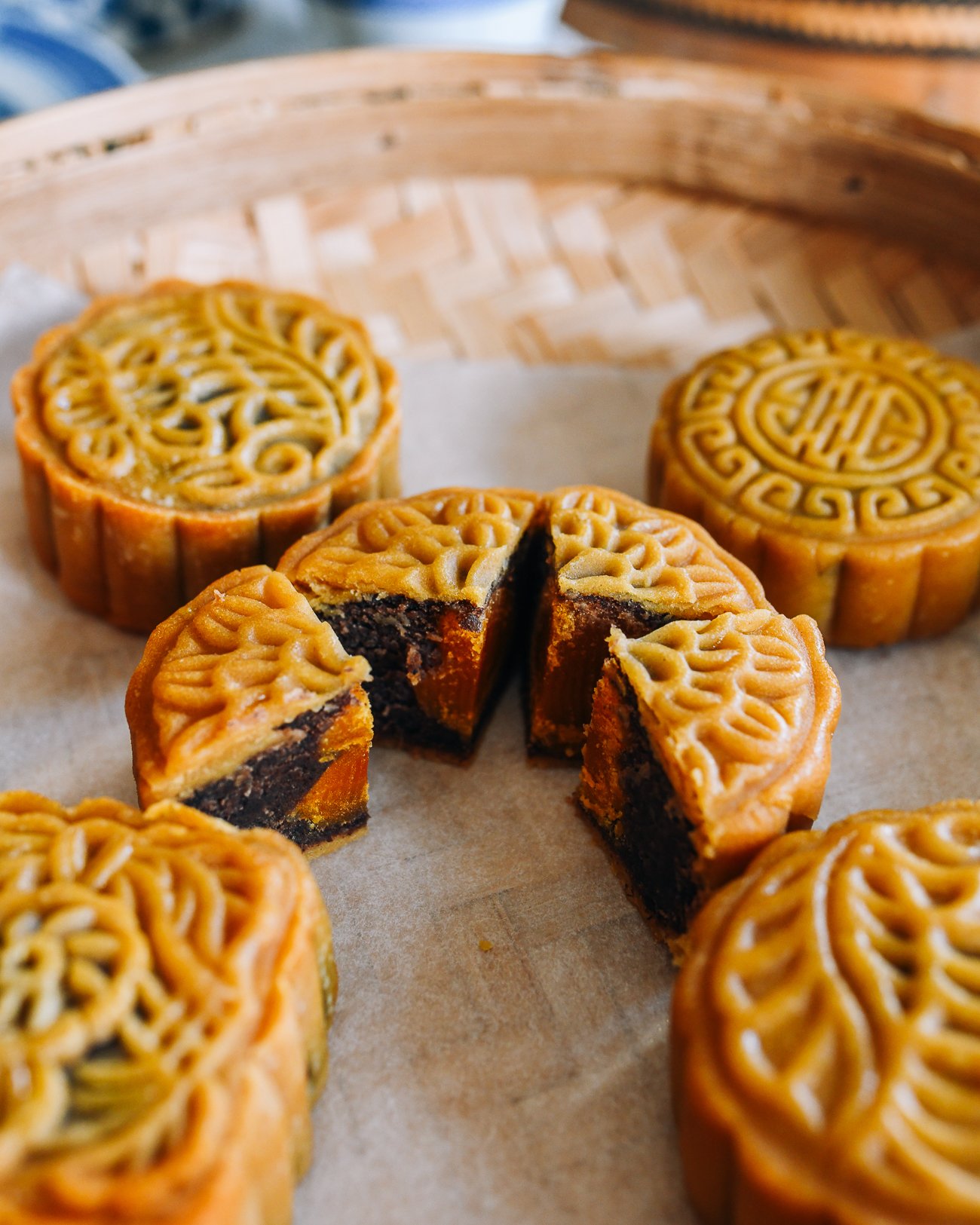
Dense, ornately pressed pastries with lotus seed paste and salted egg yolk representing the full moon. Exchanged during the Mid-Autumn Festival.
Nutrition & Info
Allergen Warnings
Equipment Needed
Presentation Guide
Vessel: decorative box or plate
Garnishes: egg wash glaze (golden)
Accompaniments: Chinese tea
Instructions
-
1
Combine the golden syrup, vegetable oil, and alkaline water in a large bowl, stirring until completely emulsified and smooth. Sift in the flour and fold with a spatula until a soft dough forms with no dry patches remaining.
-
2
Wrap the dough tightly in cling film and rest at room temperature for at least two hours or overnight. This resting period allows the gluten to relax and the syrup to fully hydrate the flour for a tender crust.
-
3
If using salted egg yolks, rinse them gently, then bake at 150C for five minutes or briefly soak in rice wine to remove any fishy odour. Each yolk will be wrapped inside a ball of filling paste.
-
4
Divide the filling paste into portions of about fifty grams each. Flatten each portion in your palm, place a salted egg yolk in the centre if using, and carefully wrap the paste around it, sealing completely.
-
5
Divide the rested dough into portions of about thirty grams each. Flatten a dough portion in your palm, place a filled paste ball in the centre, and slowly work the dough up and around until the filling is fully enclosed.
-
6
Dust the mooncake mould lightly with flour, tap out the excess, then press the filled dough ball firmly into the mould. Unmould onto a parchment-lined baking sheet by pressing the plunger evenly to release clean shapes.
-
7
Spray the mooncakes lightly with water and bake at 180C for ten minutes. Remove, brush the tops gently with a thin layer of egg wash, then return to the oven and bake for another twelve to fifteen minutes until deep golden.
-
8
Allow the mooncakes to cool completely on a wire rack, then store them in an airtight container for two to three days before eating. This crucial resting period allows the crust to soften and develop its characteristic sheen.
Did You Know?
Legend says mooncakes passed secret revolt messages during the Yuan Dynasty.
Chef's Notes
Equipment Tips
- mooncake mold
- baking sheet
- oven
- pastry brush
Garnishing
egg wash glaze (golden)
Accompaniments
Chinese tea
The Story Behind 月饼
### The Story
Mooncakes are inseparable from the Mid-Autumn Festival, a celebration with roots stretching back over 3,000 years to the Shang Dynasty's moon worship rituals. The tradition of eating mooncakes during the festival crystallized during the Song Dynasty (960-1279), but the most famous legend dates to the Yuan Dynasty (1279-1368). According to tradition, Han Chinese rebels led by Zhu Yuanzhang concealed messages inside mooncakes coordinating an uprising against Mongol rulers. The rebellion succeeded, toppling the Yuan Dynasty and establishing the Ming Dynasty in 1368, forever linking mooncakes to themes of liberation and unity.
### On the Calendar
Mooncakes are exclusively associated with the Mid-Autumn Festival, held on the 15th day of the 8th lunar month (typically September or October). Families gather to share mooncakes while admiring the full moon, symbolizing reunion and completeness.
### Then & Now
Traditional mooncakes feature a dense filling of lotus seed paste or sweet red bean paste encased in a thin, intricately stamped pastry shell, often containing a salted egg yolk representing the moon. Regional variations abound: Cantonese-style with their golden crusts, Suzhou-style with flaky pastry, and modern snow-skin mooncakes with ice cream fillings. Despite innovations, the ritual of gifting and sharing mooncakes remains unchanged.
### Legacy
The mooncake is China's most symbolically charged food -- simultaneously a pastry, a vessel of history, and an expression of family bonds that transcends generations.

Comments (0)
Log in to leave a comment.
No comments yet. Be the first to share your thoughts!