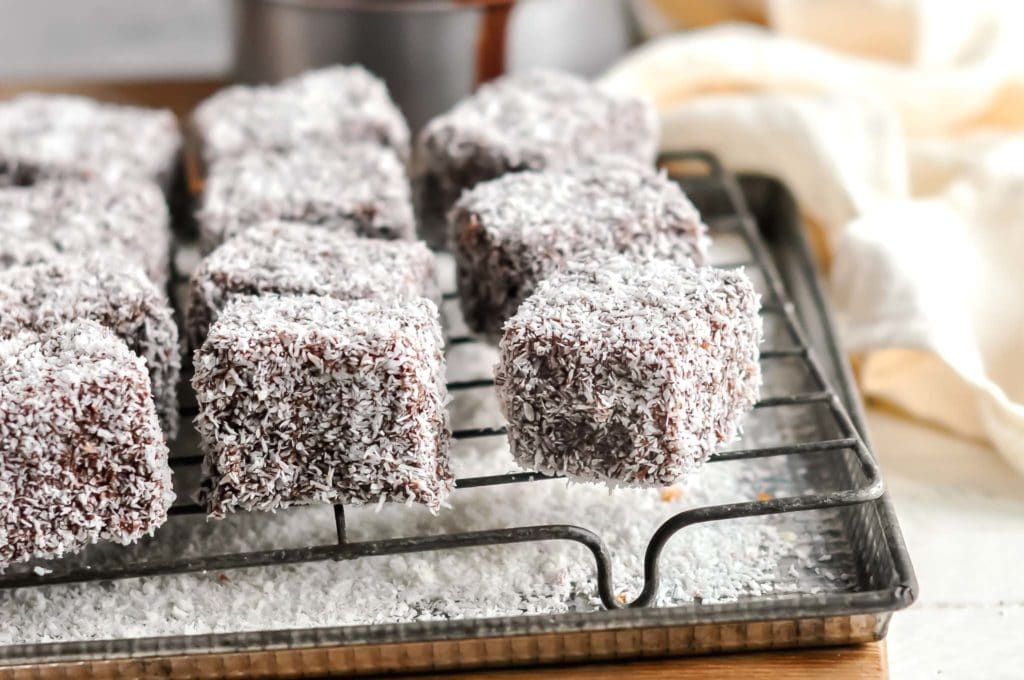
Squares of sponge cake coated in chocolate icing and rolled in desiccated coconut. Australia's national cake.
Nutrition & Info
Allergen Warnings
Equipment Needed
Presentation Guide
Instructions
-
1
Preheat the oven to 180°C/350°F and grease a 9x9-inch (23cm) square baking pan, lining the bottom with parchment paper. In a large bowl, beat the eggs and caster sugar together with an electric mixer on high speed for 5-7 minutes until the mixture triples in volume, turns pale lemon-yellow, and falls in thick ribbons from the whisk that hold their shape for 3 seconds on the surface before dissolving. This thorough beating is the key to a light, airy sponge.
-
2
Sift the flour, baking powder, and salt together, then gently fold the dry ingredients into the egg mixture in three additions using a large rubber spatula, cutting down through the center and folding over from the bottom. Combine the melted butter, warm milk, and vanilla, then fold this liquid mixture into the batter in the same gentle manner. Work quickly and carefully — overmixing will deflate the airy batter and result in a dense, heavy cake.
-
3
Pour the batter into the prepared pan and smooth the top with the spatula. Bake for 25-30 minutes until the cake is golden, springs back when lightly pressed in the center, and a toothpick inserted into the middle comes out clean. Remove from the oven and let cool in the pan for 5 minutes, then turn out onto a wire rack to cool completely. For best results, wrap the cooled cake in plastic and refrigerate overnight or freeze for 1-2 hours — a firm, cold cake is dramatically easier to cut and dip without crumbling.
-
4
Prepare the chocolate coating by sifting the icing sugar and cocoa powder into a deep, wide bowl. Add the milk, melted butter, and vanilla extract. Whisk until completely smooth with no lumps. The coating should be the consistency of thick paint — thin enough to coat the cake smoothly but thick enough to adhere without running off. If too thick, add milk 1 teaspoon at a time; if too thin, add more icing sugar.
-
5
Using a sharp, serrated knife, trim the edges of the cake for clean lines, then cut into 16 even squares (approximately 5cm/2 inches each). Working with one cube at a time, spear it on a fork or dipping tool, dip it completely into the chocolate coating, turning to cover all sides evenly. Let the excess coating drip off for a few seconds, then immediately transfer to the plate of desiccated coconut.
-
6
Roll and press the chocolate-coated cube gently in the coconut, turning to coat all six sides evenly and thoroughly. The coconut should stick to the wet chocolate coating in a thick, even layer. Place the finished lamington on a wire rack set over a baking sheet to set. Repeat with all remaining squares, stirring the chocolate coating occasionally and whisking if it thickens.
-
7
Allow the lamingtons to set at room temperature for at least 30 minutes until the chocolate coating firms up and the coconut adheres solidly. Serve at room temperature with tea or coffee. For an extra-special variation, slice each lamington horizontally, spread with whipped cream and strawberry jam, and sandwich back together before serving. Store in an airtight container at room temperature for up to 3 days.
Did You Know?
Lamingtons were named after Lord Lamington, Governor of Queensland, though he reportedly called them 'those bloody poofy woolly biscuits.'
Chef's Notes
Equipment Tips
- baking pan
- mixing bowls
- wire rack
- dipping forks
Garnishing
desiccated coconut
Accompaniments
whipped cream, tea
The Story Behind Lamington
The Story: The lamington is a cube of sponge cake dipped in chocolate icing and rolled in desiccated coconut, claimed as Australia's national cake. Most commonly attributed to Lord Lamington, Governor of Queensland from 1896 to 1901, whose cook reportedly created it to use up stale sponge. Lamingtons became fixtures of Australian bakeries, school fundraisers, and afternoon teas by the early twentieth century.
On the Calendar: Lamingtons peak around Australia Day and at community fundraising events, where lamington drives are a beloved tradition.
Then & Now: Traditional lamingtons coexist with modern variations including raspberry, passionfruit, and salted caramel, but the classic chocolate-and-coconut version remains supreme.
Legacy: The lamington is proof that Australia's greatest culinary contributions are often the simplest, unpretentious, sweet, and shared.
More Australian Dishes
 Easy
📜 Story
Easy
📜 Story
ANZAC Biscuits
ANZAC Biscuits
ANZAC Day, afternoon tea Medium
📜 Story
Medium
📜 Story
Aussie Burger with the Lot
Australian Burger with the Lot
Lunch or dinner Medium
📜 Story
Medium
📜 Story
Aussie Meat Pie
Beef Meat Pie
Lunch, snack, any time Easy
📜 Story
Easy
📜 Story
Aussie Prawn Cocktail
Australian Prawn Cocktail
Christmas lunch starter, summer entertaining
Comments (0)
Log in to leave a comment.
No comments yet. Be the first to share your thoughts!