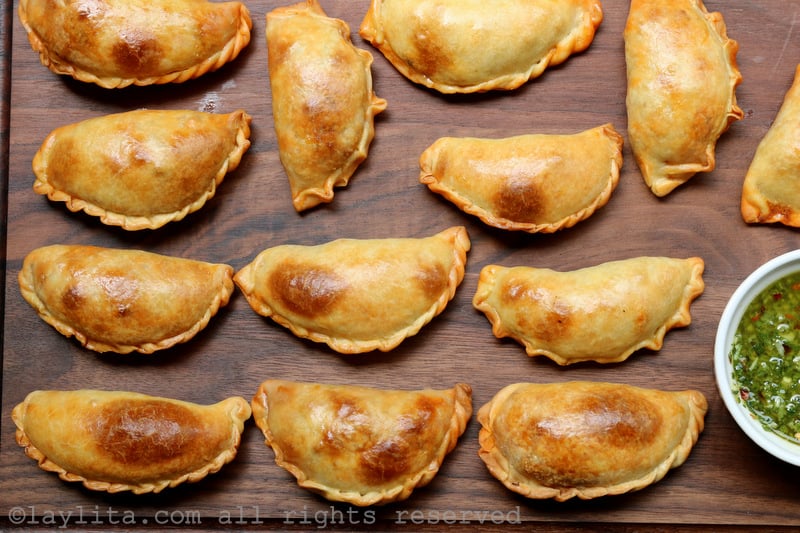
Golden baked pastry pockets filled with seasoned beef, onions, olives, and hard-boiled eggs. Every Argentine province has its own signature style and fierce local pride.
Nutrition & Info
Allergen Warnings
Equipment Needed
Presentation Guide
Vessel: rustic wooden board
Garnishes: chimichurri
Accompaniments: green salad, salsa criolla
Instructions
-
1
Heat 1 tablespoon of oil in a large skillet over medium-high heat until shimmering. Add the finely diced onions and cook for 6-8 minutes, stirring occasionally, until they turn translucent and just begin to color at the edges. Add the small-cubed beef, cumin, paprika, and red pepper flakes. Cook for 5-7 minutes, stirring to break up any clumps, until the beef is browned through and the spices are fragrant. Season with salt and pepper. The filling should be moist but not wet — if there is excess liquid, cook uncovered for 2-3 minutes to evaporate it.
-
2
Transfer the filling to a bowl and fold in the halved green olives. Allow the mixture to cool completely to room temperature, then refrigerate for at least 30 minutes. Cold filling is essential — warm filling creates steam inside the empanada during baking, causing the dough to become soggy and the seal to burst open. While the filling chills, prepare your egg pieces and preheat the oven to 200°C/400°F.
-
3
Lay the empanada dough discs on a clean work surface. Place approximately 2 heaping tablespoons of the chilled beef filling on the lower half of each disc, leaving a 1-inch border. Add a piece of hard-boiled egg and two olive halves to each empanada. Be careful not to overfill — overstuffed empanadas are difficult to seal and prone to bursting in the oven.
-
4
Moisten the edges of each disc with your fingertip dipped in water. Fold the top half of the dough over the filling to create a half-moon shape. Press the edges firmly together to seal, then create the traditional repulgue by folding small pleats along the sealed edge, pinching each fold tightly. The repulgue is not merely decorative — it identifies the filling and ensures a tight seal. Each empanada should have 10-13 uniform pleats.
-
5
Place the assembled empanadas on parchment-lined baking sheets, spacing them 1 inch apart. Brush the top and edges of each empanada with the egg wash, which gives them a beautiful glossy, golden finish. Use a toothpick to poke a small steam vent in the top of each one to prevent them from puffing up and bursting during baking.
-
6
Bake in the preheated oven for 20-25 minutes, rotating the sheets halfway through, until the empanadas are uniformly deep golden brown with a flaky, crisp shell and the bottoms are set and lightly colored. Remove from the oven and let them cool for 5 minutes on the sheet before serving. Serve warm with chimichurri sauce on the side — these empanadas should have a crispy exterior that shatters on the first bite, revealing the juicy, spiced beef filling within.
Did You Know?
In Argentina, empanada repulgue (the edge crimping pattern) varies by province — you can tell where an empanada is from just by looking at its edges.
Chef's Notes
Equipment Tips
- mixing bowl
- rolling pin
- baking sheet
- sharp knife
Garnishing
chimichurri
Accompaniments
green salad, salsa criolla
The Story Behind Empanadas
The Story: Argentine empanadas descend from Spanish empanadas but have developed into a distinctly national art form with dramatic regional variations. Each province has its own filling, dough style, and folding technique: Salta favors beef with potato and cumin in a baked shell, Tucuman uses hand-chopped beef in a fried version, and Mendoza adds olives. The repulgue (decorative crimped edge) identifies each empanada's filling and province of origin, a visual code developed over centuries.
On the Calendar: Empanadas are eaten at asados, family gatherings, sporting events, and as everyday street food. The Fiesta Nacional de la Empanada in Famailla, Tucuman, celebrates the dish annually in September.
Then & Now: While each province fiercely defends its version, empanadas remain a unifying national food. They are ordered by the dozen in mixed assortments, with the repulgue pattern guiding diners to their preferred filling.
Legacy: Argentine empanadas are a map of the nation's geography and culture, each fold and filling telling the story of its home province.


Comments (0)
Log in to leave a comment.
No comments yet. Be the first to share your thoughts!